How long does a wet screed take to dry before I can tile?
Traditional sand and cement is roughly one day per millimetre for the first fifty millimetres, so a normal domestic floor is weeks rather than days. Liquid screeds are quicker, and the fast-drying products quicker again, with some ready for a covering inside a week. Drying is also about the building, so heat and air movement matter as much as the product.
Should I use liquid screed or sand and cement?
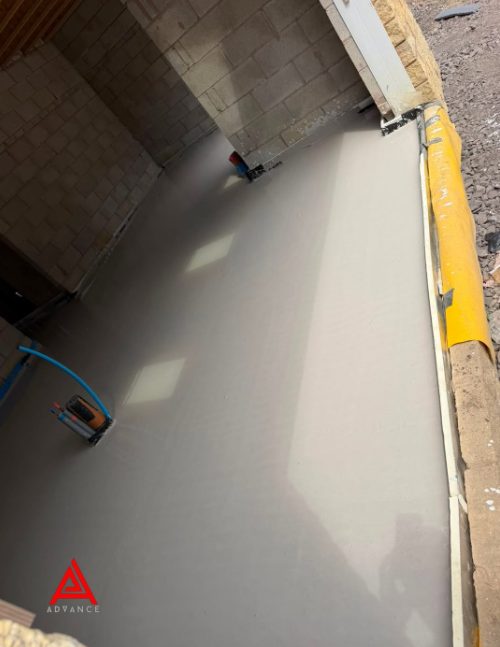
Liquid screed is pumped, self levelling and covers a big area fast, which makes it the sensible choice on open plan floors and over underfloor heating because it flows completely round the pipes with no voids. Sand and cement is laid by hand and worked, which suits small rooms, patches, falls to a gully and anywhere a pump cannot get to. Both finish flat. They just suit different jobs.
How thick does a wet screed need to be?
A bonded screed on a sound slab is usually 25 to 40mm, unbonded 50mm and up, and a floating screed over insulation more again, with cover needed above any heating pipes. The right number comes off your build up and your loading, so it gets worked out for the actual floor rather than assumed off a chart.
Does a liquid screed need sanding before flooring goes down?
Most anhydrite screeds form a thin surface laitance as they cure and it has to come off before an adhesive will bond. That is a light mechanical sand and a vacuum, usually a week or so after the pour. It is a small job that gets skipped surprisingly often, and skipping it is why coverings lift.
Can you pump a liquid screed into my building?
Usually yes. Hose can be run a long way and up through a building, so access is rarely the thing that stops it. What we need to know first is where the wagon can stand, how far the hose has to travel and whether the floor is sealed enough to hold a fluid screed, which is what the site visit is for.