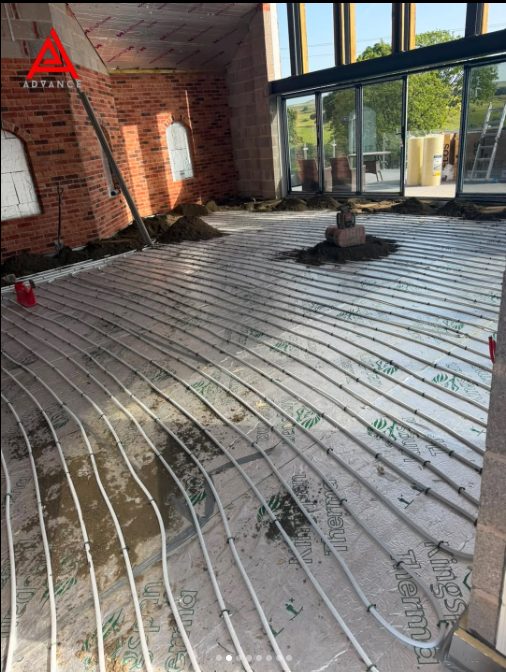
Is underfloor heating cheaper to run than radiators?
It usually is, because it works at a much lower flow temperature over a much bigger surface. That gap gets wider with a heat pump, where the lower the flow temperature the better the efficiency. Where it does not pay off is a badly insulated floor, so the insulation under the pipes matters as much as the pipes.
Can underfloor heating go in an existing house?
Yes, though the floor build up decides how. Where you can dig out or lose some height, a normal insulated build up with screed over the pipes is the best answer. Where you cannot, low profile systems exist that add very little height. It is worth getting someone to look at the floor rather than guessing off a website.
How long does the screed over underfloor heating take to dry?
Same rules as any screed, and it must not be heated early. A liquid screed can often take a covering in a week or two and a traditional screed will take longer, then the heating gets brought up slowly through a proper commissioning cycle. Turning it on hard to speed things up is how you crack a floor.
What flooring can go over underfloor heating?
Tile and stone are the best conductors and the natural fit. LVT and engineered wood are fine provided the manufacturer allows it and the surface temperature is limited. Thick carpet and heavy underlay work against you. Tell us what is going down at the quote stage and the design accounts for it.
What happens if a pipe leaks under the screed?
It is very rare, because the pipe is continuous within each circuit with no joints buried in the floor, and every circuit is pressure tested and left under pressure while the screed is poured. That test is exactly what stops a buried problem.